how we sweat
the glands
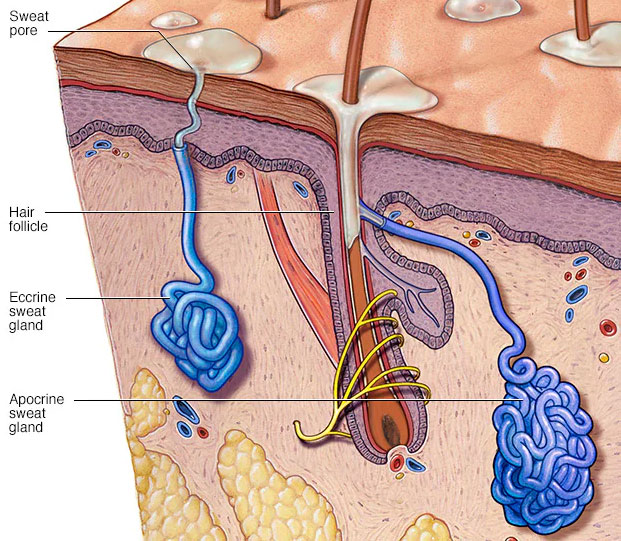
There are three types of sweat gland in the body. The eccrine glands are the most numerous and produce the watery sweat that cools the body and are responsible for the excessive sweating of hyperhidrosis.
The apocrine glands produce a thicker oily secretion into the hair follicle and are found mostly in the underarms, groin, ear canal and eyelids.
A third type, the apoeccrine glands have features of both types and are found mostly in the armpits and groin.
The apocrine glands produce a thicker oily secretion into the hair follicle and are found mostly in the underarms, groin, ear canal and eyelids.
A third type, the apoeccrine glands have features of both types and are found mostly in the armpits and groin.
the eccrine glands
These watery sweat-producing glands are found all over the body but they are more densely packed on the palms of the hands, soles of the feet, underarms and forehead. The glands have tubes known as ducts that open directly on to the skin surface so the watery salty sweat that is produced evaporates and cools the skin down.
Antiperspirants and iontophoresis cause blockage of the ducts so that the sweat can no longer reach the surface. The sweat is still produced but gets absorbed back into the body in the ducts. In hyperhidrosis the eccrine glands are no bigger or greater in number, they are just more active through overstimulation by the sympathetic nerves (see below).
Antiperspirants and iontophoresis cause blockage of the ducts so that the sweat can no longer reach the surface. The sweat is still produced but gets absorbed back into the body in the ducts. In hyperhidrosis the eccrine glands are no bigger or greater in number, they are just more active through overstimulation by the sympathetic nerves (see below).
the nerves
The human body has three groups or systems of nerves. The sensory nerves allow us to sense touch, pain, hot, cold, taste, smell, hear and see. The motor nerves stimulate our muscles to enable us to move. The autonomic nervous system control all the body activities we generally don’t need to think about including pupil constriction or dilation, salivation, heart and breathing rate, digesting food and going to the toilet.
The autonomic nervous system has two sides, sympathetic and parasympathetic. The sympathetic nerves get the body ready for action (“fight or flight”) by dilating the pupils, increasing the heart rate, opening up the airways, slowing down the intestines, diverting blood from the skin to the muscles and stimulating the production of adrenaline by the adrenal glands (which sit on top of the kidneys). The sympathetic nerves release noradrenaline (norepinephrine) to make their actions happen.
The parasympathetic nerves control the body at other times and when at rest by slowing down the heart, increasing salivation and intestinal activity and allowing us to go to the toilet. The parasympathetic nerves release a chemical called acetylcholine to stimulate the organs and tissues.
Sweating is controlled by the sympathetic part of autonomic nervous system. Unlike the rest of the sympathetic nervous system the chemical that enables the effect is not noradrenaline but acetylcholine as in the parasympathetic nervous system. That means if drugs that block acetylcholine (anticholinergics) are given they will reduce sweating. However, they will also block the function of the parasympathetic nerves elsewhere in the body. The result is many unwanted, but predictable effects, including dry mouth and eyes, decreased gut motility resulting in constipation and difficulty urinating. For that reason, anticholinergic medications for hyperhidrosis are not well tolerated by most patients.
The precise cause of overactivity of the sympathetic nerves in hyperhidrosis is not understood but it is thought the it originates centrally in the brain, probably in the hypothalamus which controls all the autonomic functions. To learn more about this autonomous world beneath our skin the MSD manual explains it in detail here.
The autonomic nervous system has two sides, sympathetic and parasympathetic. The sympathetic nerves get the body ready for action (“fight or flight”) by dilating the pupils, increasing the heart rate, opening up the airways, slowing down the intestines, diverting blood from the skin to the muscles and stimulating the production of adrenaline by the adrenal glands (which sit on top of the kidneys). The sympathetic nerves release noradrenaline (norepinephrine) to make their actions happen.
The parasympathetic nerves control the body at other times and when at rest by slowing down the heart, increasing salivation and intestinal activity and allowing us to go to the toilet. The parasympathetic nerves release a chemical called acetylcholine to stimulate the organs and tissues.
Sweating is controlled by the sympathetic part of autonomic nervous system. Unlike the rest of the sympathetic nervous system the chemical that enables the effect is not noradrenaline but acetylcholine as in the parasympathetic nervous system. That means if drugs that block acetylcholine (anticholinergics) are given they will reduce sweating. However, they will also block the function of the parasympathetic nerves elsewhere in the body. The result is many unwanted, but predictable effects, including dry mouth and eyes, decreased gut motility resulting in constipation and difficulty urinating. For that reason, anticholinergic medications for hyperhidrosis are not well tolerated by most patients.
The precise cause of overactivity of the sympathetic nerves in hyperhidrosis is not understood but it is thought the it originates centrally in the brain, probably in the hypothalamus which controls all the autonomic functions. To learn more about this autonomous world beneath our skin the MSD manual explains it in detail here.