what is hyperhidrosis?
Hyperhidrosis is sweating beyond what is required to control the body temperature whether at rest in cool environments or when going about daily activities. Most people with hyperhidrosis have primary hyperhidrosis which starts when young. Adults often develop sweating later in life and this is most likely secondary hyperhidrosis.
what is primary hyperhidrosis?
This is the most common form of hyperhidrosis. It begins in childhood or adolescence and affects the hands and feet. Other body areas including the underarms (the axilla), face and groin can also be affected especially from adolescence onwards. For this reason, it is often called focal hyperhidrosis to distinguish it from sweating all over or generalised hyperhidrosis which is secondary.
It disrupts daily life and activities and has no consistently identifiable triggers. A very important characteristic of primary hyperhidrosis to differentiate it from other causes is that it is not present when asleep.
The cause of primary hyperhidrosis is not known which is why it is sometime referred to as idiopathic hyperhidrosis.
In primary hyperhidrosis, people experience sweating episodes more than two times a week and sweating can occur whatever the temperature and it interferes with daily activities most people take for granted.
In as many as half the people with primary hyperhidrosis it is inherited. It is likely that parents or siblings also experience the condition. No actual gene has yet been identified but the Mendelian pattern of inheritance is autosomal dominant. That means if an individual is affected there is a 50/50 chance it can be passed to their offspring.
It disrupts daily life and activities and has no consistently identifiable triggers. A very important characteristic of primary hyperhidrosis to differentiate it from other causes is that it is not present when asleep.
The cause of primary hyperhidrosis is not known which is why it is sometime referred to as idiopathic hyperhidrosis.
In primary hyperhidrosis, people experience sweating episodes more than two times a week and sweating can occur whatever the temperature and it interferes with daily activities most people take for granted.
In as many as half the people with primary hyperhidrosis it is inherited. It is likely that parents or siblings also experience the condition. No actual gene has yet been identified but the Mendelian pattern of inheritance is autosomal dominant. That means if an individual is affected there is a 50/50 chance it can be passed to their offspring.
how can primary hyperhidrosis be treated?
When it comes to treating hyperhidrosis there are a number of possibilities. Not every treatment works for everybody as in all areas of medicine.
Some treatments are more suitable for certain areas of the body but there are some simple measure that most people find helpful including wearing loose fitting clothes made from natural fibres (cotton, linen, wool, silk) that allow air exchange with the skin. Socks that absorb moisture and leather shoes which also absorb moisture. Wearing a different pair of shoes on different on alternate days allows them to dry out in between wearing. Barriers and absorbent materials worn under clothing will prevent sweat marks showing through clothes. Some people with hyperhidrosis shower or bathe frequently; if this is the case then it is advisable to use emollient washes rather than soaps to preserve the natural skin oils.
Referral by your doctor (GP) to dermatologist is the usual recommended course of action for primary hyperhidrosis after antiperspirants have been tried. Not all Integrated Care Boards fund hyperhidrosis treatment. Those that do will likely offer a course of iontophoresis to verify it works for you. They would then discharge you and encourage you to purchase your own device for continuing treatment at home. Some people bypass this process and purchase their own iontophoresis device to treat themselves.
In most of the world, the management of primary hyperhidrosis follows a hierarchy similar to that below, where the next treatment is attempted if the previous one fails:
Some treatments are more suitable for certain areas of the body but there are some simple measure that most people find helpful including wearing loose fitting clothes made from natural fibres (cotton, linen, wool, silk) that allow air exchange with the skin. Socks that absorb moisture and leather shoes which also absorb moisture. Wearing a different pair of shoes on different on alternate days allows them to dry out in between wearing. Barriers and absorbent materials worn under clothing will prevent sweat marks showing through clothes. Some people with hyperhidrosis shower or bathe frequently; if this is the case then it is advisable to use emollient washes rather than soaps to preserve the natural skin oils.
Referral by your doctor (GP) to dermatologist is the usual recommended course of action for primary hyperhidrosis after antiperspirants have been tried. Not all Integrated Care Boards fund hyperhidrosis treatment. Those that do will likely offer a course of iontophoresis to verify it works for you. They would then discharge you and encourage you to purchase your own device for continuing treatment at home. Some people bypass this process and purchase their own iontophoresis device to treat themselves.
In most of the world, the management of primary hyperhidrosis follows a hierarchy similar to that below, where the next treatment is attempted if the previous one fails:
For people with primary hyperhidrosis we recommend the following products.
IXAL is an aluminium-free antiperspirant developed specifically for the treatment of hyperhidrosis. Aimed at underarm use it can also be used on other skin areas
Saalio is a modern tap water iontophoresis device which has designed out the poor features and shortcomings of previous devices. With safety and useability at its core we consider this the leading device available today.
Endoscopic thoracic sympathectomy (ETS) surgery to permanently stop the sympathetic nerves to the sweat glands working is considered very much a treatment of last resort because of the significant potentially life changing side effects.
Each of these treatments has their own page that you can access through the menu or by clicking on the boxes.
Additional treatments are available just for the underarms including local surgery, laser treatment, miraDry and topical anticholinergic medications. (link treatment pages).
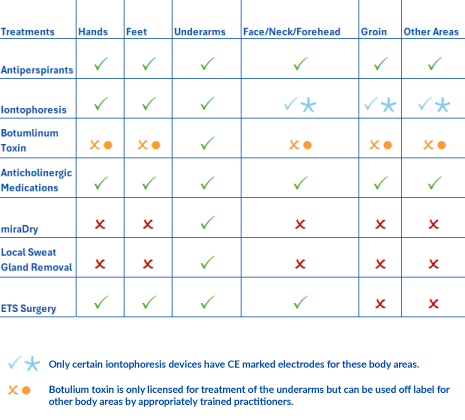
The table below gives a guide to what treatments are suitable for which parts of the body affected by hyperhidrosis.
Get talking
Primary hyperhidrosis is a lifelong condition and as with other chronic illnesses cognitive behavioural therapy (CBT) can be very helpful to individuals. The NHS has talking services and cognitive behavioural therapy (CBT) available which can be accessed in some instances without referral or via referral from your GP. The NHS Every Mind Matters page offers some self-help CBY techniques.
In Scotland, Living Life is a telephone service to help you understand what is affecting you and help develop strategies to manage your mental health.
Some UK based charities also offer services to help with anxiety and mental health including:
- Mind
- Anxiety UK
- Power to Live Foundation
- Rethink Mental Illness
Many employers offer schemes to help mental health in the workplace through Employee Assistance Programmes. These are usually provided by a third party.
In Scotland, Living Life is a telephone service to help you understand what is affecting you and help develop strategies to manage your mental health.
Some UK based charities also offer services to help with anxiety and mental health including:
- Mind
- Anxiety UK
- Power to Live Foundation
- Rethink Mental Illness
Many employers offer schemes to help mental health in the workplace through Employee Assistance Programmes. These are usually provided by a third party.